
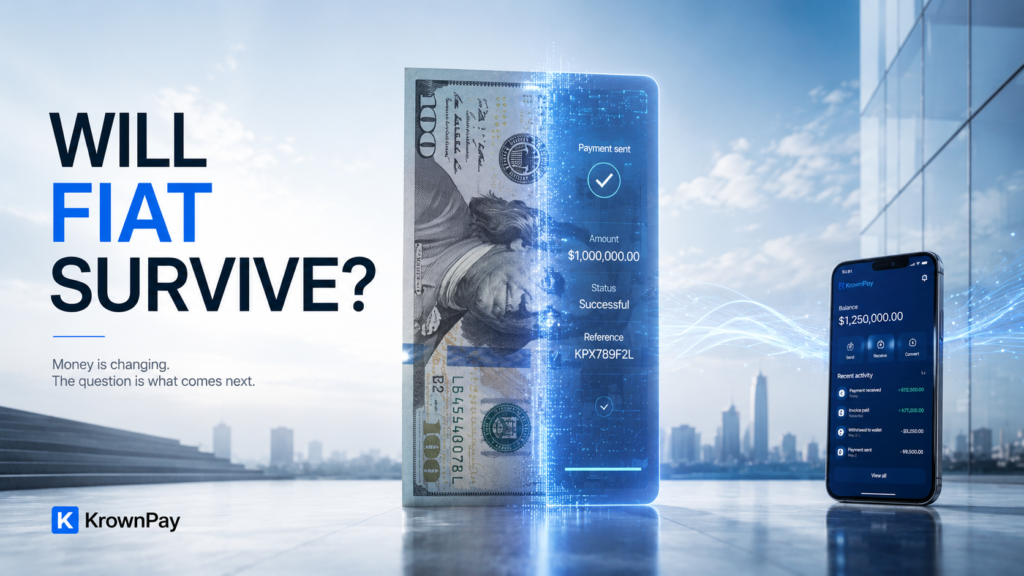
What Do you Think?
For most of us, money is something we rarely question.
You get paid in it. You save it. You spend it. You send it to someone else.
It feels permanent because it has always been there.
But the way we move money is changing quickly.
Today, someone in Lagos can do business with a client in London, receive a dollar-pegged digital asset on a phone, and convert it into local currency without the payment following the traditional path we grew up with.
So, will fiat survive?
Probably. But it may not remain the only way we experience money.
That distinction matters.
Money Has Always Evolved
Before banknotes, there were coins. Before modern banking, there were other ways of recording and transferring value.
Then came bank transfers, cards, mobile money and digital banking.
The money did not necessarily disappear.
The way we accessed it changed.
That is what makes today’s shift interesting.
The question may not be whether the dollar, naira, euro or pound disappears.
The bigger question is:
Will the systems we use to move those currencies look the same ten years from now?
Stablecoins Are Making That Question Harder to Ignore
Stablecoins are digital assets designed to maintain a stable value relative to an underlying asset, most commonly the US dollar. Unlike assets such as Bitcoin, their purpose is generally to avoid large price swings.
And their use is no longer something happening only inside crypto communities.
They are increasingly being used for cross-border transactions.
For someone receiving money internationally, that can be important.
Imagine a freelancer in Nigeria working with a client thousands of kilometres away.
The client wants to pay.
The freelancer wants the money.
Neither of them really cares about the complicated infrastructure sitting between those two points.
They care about three things:
Did the money arrive?
How long did it take?
How much value was lost along the way?
That is where digital dollar-denominated payment rails become interesting.
But this is not simply a story about “crypto replacing banks.”
It is much more complicated than that.
The Uncomfortable Part
There is a reason central banks are paying attention.
Most stablecoins are dollar-denominated. As their use grows, people in countries with weaker currencies may increasingly hold or transact in digital dollars instead of their local currency.
That creates a real tension.
On one hand, people want faster, cheaper and more accessible ways to move money.
On the other, countries need monetary systems they can manage and trust.
Both things can be true at the same time.
And that is why the future of money should not be discussed as simply:
Fiat vs. Crypto.
The real conversation is about infrastructure, access, trust and choice.
So, Will Fiat Survive?
Our guess?
Yes.
But surviving does not mean staying unchanged.
Fiat may continue to be the money people use every day, while digital assets and tokenised forms of money increasingly become part of the infrastructure underneath how money moves.
In other words, the future might not be about one form of money winning.
It might be about different forms of money becoming useful for different things.
And that is where things get interesting.
The Future Isn’t Asking Permission
For businesses and freelancers working across borders, this conversation is not theoretical.
The payment system you use can affect how quickly you get paid, how easily you work with international clients and how much value survives the journey.
At KrownPay, this is the part of the future we care about.
Not replacing money for the sake of replacing it.
Not making payments complicated because the technology is exciting.
Simply asking:
Can moving money for people who work across borders be better?
Because maybe the biggest change in money isn’t what sits in your wallet.
Maybe it’s how easily that money can move.
And if that changes, the question isn’t only whether fiat will survive.
It’s what money will look like when it does.
This article is intended as an educational perspective, not financial or tax advice.